Showing posts with label feminism. Show all posts

Wednesday, 6 March 2013

0 The new Lara Croft and That Scene

When I woke up this morning, I was looking forward to reading all the first-play reviews of the new Lara Croft instalment (and a bit for reviews of Sims 3: University Life, but the less we talk about my addiction to that the better). I was so excited that I completely forgot about the highly talked about and criticised 'rape origin story' until I logged into Twitter and found it waiting for me.


Violence towards women in video games has a sadly rich history. If female characters aren't being beaten, they're being sexualised, or quite often both. I wanted to give an example of an early playable female character in my gamer life, but the only one I can think of really is Lara Croft;  she was touted as the bad-ass woman every girl can look up to, but as a rather short nine year old it would have been difficult for me to do that with her comically large breasts in the way. One of the most recent examples I can give is from Batman: Arkham City, where every thug was calling Catwoman a bitch and making inappropriate comments about what they'd do if they found her. No-one was calling Batman a bitch, partly because there is no male equivalent to the word, partly because he will promptly arrive and grind your face into the concrete. However, even if we take all of that into account, what surprised me was how many people were shocked that men would say nasty, sexist things. So (for me, anyway) the question becomes whether, in the fight against sexism in video games, we remove sexism and violence towards women altogether or portray it properly.


Everything about the Tomb Raider revamp had me ready to play it as soon as possible. I had no idea the last incarnation of Lara even had a backstory, since it was never played out by the character and only really mentioned quite hammily every now and then - "Oh Alfred, I must go and fetch that artefact from that guy because my parents died in a plane crash and he served them some peanuts and lived." Much like everyone else, though, I was somewhat shocked by the 'rape' scene that would form part of her back story. She was already going to be pretty tough after surviving on a hostile island did she really need to be raped as well?


One of the main problems was that it all escalated quickly from being an attempted rape scene to a rape origin story - apparently, it turned out to be neither. Rihanna Pratchett, the story writer for Tomb Raider (and whose glorious existence I only learned about this week) had this to say about the scene:
"When you see the scene in context, you see the light leave the guy's eyes [...]. She just can't believe what she's done. She's not thinking, 'Oh my God, I was almost raped.' She's thinking, 'Oh my God, I've just taken a human life.' It's unfortunate that if you have a female protagonist and male antagonists, and they're coming after her, people see that vibe." - from an interview with Eurogamer
All the playthroughs so far back her statement up, and every trope has been disproved; it isn't glorified, she doesn't enjoy it, she doesn't automatically lose, she isn't weaker, and it wasn't her fault.


The thought that popped into my still blearily sleep-fuddled head this morning was this: a lot of the arguments are talking about rape like it's a thing that never happens to young women, like its a rare thing that's never ever used against them - like the genuine attempt to use violent sexual behaviour to overpower a young woman is unrealistic. When men are told about the rape statistics for women, and how women can feel threatened even when they aren't being threatened thanks to a society that doesn't talk about rape and blames the victim, they rarely, truly, understand it. In the new Tomb Raider game they have to play through an attempted sexual assault on a woman, and for a lot of male gamers it's going to be uncomfortable and confusing because they've never experienced it from that side - but most importantly, they're talking about it.


Ultimately, I feel the attempted assault on Lara has it's place. Some dick who thinks he's tougher than this frail-looking stranded survivor is likely to try and take violent advantage of her; it isn't about him, though, it's a scene about Lara being forced into a corner and taking her first life. This doesn't mean the game industry should start cranking out games with female characters who are rape survivors or it'll just become another form of origin story, but the new Tomb Raider feels like a step forward in the realistic portrayal of women in video games.

UPDATE: like a rough to cover a diamond in more rough, Team Fortress have decided to give their Croft Crest badge this super flattering description. (via @DickMandrake)



Wednesday, 8 February 2012

2 Pulling a rabbit out of a hat, and your foot out of your mouth

Here's something you probably don't know about me - unless you know me in person or are Stuart, then you'll definitely know - I love magic. My dad regularly appears out of nowhere asking me (or, on one occasion, everyone at my 21st birthday party) to pick a card; I am not, however, that good at performing tricks. I don't have the patience, and once I know how its done I lose interest. Essentially, I lie in the Jonathan Creek, 'ah yes very clever', knowledge of Houdini beyond the water tank category. Sort of a magic historian, I guess.  My favourite magicians, excluding individual performers and assistants, are Penn & Teller.

They were always the stuff of legends to me growing up, with my dad recording clips of the television to make me gasp with tiny wide-eyed awe. I spent years reading about their Las Vegas show, wanting desperately for them to perform here and feeling a retrospective cosmic annoyance that I was born just after their last UK performance. Then, a couple of years ago, they began announcing UK shows. I managed to get tickets five rows from the stage, and lured my dad down to London with minimal details of what I had planned; it was everything I wanted it to be, and quite a few things I didn't even expect. Teller is a master of sleight-of-hand, and I was practically convulsing with excitement when he performed the trick I had dreamed of seeing live:


I love it. I know how its done, I think I know how its done, but I still love it, because I don't know for sure. Sadly, in a world of unlimited digital social interaction and constant live updates, there are some things I know for definite that I wouldn't have known, had I not seen it on the internet; I'd still find Alan Davies funny, I could successfully avoid Justin Bieber fans, and I wouldn't know that Penn can be an absolute tool.

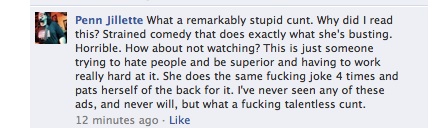
The old 'don't meet your heroes' thing rears its ugly head in the form of a highly unpleasant Facebook comment, in which he uses my favourite contentious word:


See, I wouldn't have a problem if he was insulting everyone. He's always been very vocal about his opinions, but this is just oddly uncalled for; if he went after every T4 presenter too I'd feel a bit better knowing he hated all forced comedy equally, but because the internet is so vast situations like this look very specific.

This has sparked a great debate about misogyny, gender based insults, and how he clearly went after her because she's a woman. I'm going to be unpopular, disagree, and wave my double-edged sword at you.

I regularly see the term 'don't be a dick' bandied around, and the people that oppose 'cunt' never seem to challenge it. I don't think the answer here is to avoid gender-based insults, otherwise that would leave us with about two swear words, but rather we should make the distinction between people who do consider everyone of that gender to be evil, and people who are just swearing. There is nothing you can yell at someone in anger that doesn't involve gender and isn't from a Shakespearian play.

Yes, he was completely unjustified in making such a personal and unwarranted attack on the woman's own work, but that doesn't make him a mysogynist. I'm sure if he was, his wife would have left him by now, his wouldn't make regular tributes to his mother, and he never would have invented the Jill-Jet (but Debbie Harry did help).

The sum of the whole is ultimately greater than its parts, and if the media has taught us anything its that even criminal misdemeanors can be overlooked with time. Just look at Chris Brown (but make sure you duck).

I found another article, written by a friend of Penn's denouncing the idea that atheism and nerddom is a boy's club. Strangely, this was taken to be an entirely anti-feminist post on how women should just accept men for the tossers they are and women should be like men, and a million other things she didn't actually say. Mallorie says that she's never had a problem with the geekier men in her life, that they treat her like they treat everyone else and do not offer her the dainty sensibilities women are usually treated to. She gets along with men! The horror!

She does not, as this post claims, call all women who complain about inequality " humorless,  overemotional, and anti-sex". It isn't even aimed at other women, but at men who feel attacked for not behaving the right way. There are men in the geek community who are absolute tools, I've met them, but there are also women who characterise geeks as being good looking gentlemen in retro glasses and then complain at large when it turns out that plenty of geeks aren't. If I had a share in Fox for every time I've had to listen to various women talk about how much they hate Halo and are going to sell their boyfriend's Xbox and throw out all his Star Wars shirts, we'd be on series ten of Firefly right now. From my own experience, I know it looks like a boy's club, but it isn't; we may be socialised to think it is, look at any gaming advert, but that isn't real life. When my flatmate had some friends around to play Halo, I stopped by to say hello, and this is almost exactly what happened:

Me: Are you playing Halo?
Flatmate: Yes. Do you play?
Me: Yes.
Flatmate: Okay, cool.

And then I made myself a cup of tea and got on with my life.

The reason I think these two seperate events tie in so well is because in both cases people are generalising their expectations, then getting defensive when everyone doesn't agree. Penn is a dick sometimes, but he doesn't, as far as I know, hate women. Until he does something explicitly aimed at demoralising women, I'm not with you. Similarly not all geek men are Dr. Spencer Reid from Criminal Minds, and most rational people can comprehend that. This doesn't mean they should be attacked for sharing a positive social experience. In a way I suppose its another form of my rule about canon; if you like games, its fine, just don't expect a big giant fuss about it like a girl holding a controller is something special.It isn't, its life, it happens, get on with it and be happy.

Thursday, 29 December 2011

2 Embracing (or equality for) the Mary Sue

I've just come across this Tumblr post denouncing the term Mary Sue as sexist; I've been hanging around in fiction communities since I was little and have a very good idea of what a Mary Sue is, but I'd never considered it's negative effects beyond, well, bad fiction. This looked like a good article to start with... and then I read the first paragraph:

So, there’s this girl. She’s tragically orphaned and richer than anyone on the planet. Every guy she meets falls in love with her, but in between torrid romances she rejects them all because she dedicated to what is Pure and Good. She has genius level intellect, Olympic-athelete level athletic ability and incredible good looks. She is consumed by terrible angst, but this only makes guys want her more. She has no superhuman abilities, yet she is more competent than her superhuman friends and defeats superhumans with ease. She has unshakably loyal friends and allies, despite the fact she treats them pretty badly.  They fear and respect her, and defer to her orders. Everyone is obsessed with her, even her enemies are attracted to her. She can plan ahead for anything and she’s generally right with any conclusion she makes. People who defy her are inevitably wrong.  
 God, what a Mary Sue.
I just described Batman.
No, no you didn't. You described how you see Batman. He is orphaned, which helps create him. Its an origin story, and I guarantee you there's much worse; he is rich too, but he spends most of his time trying to escape the image associated with it - part of the reason he's such a dedicated crime fighter is that he's desperate to give something other than his money. He isn't so intelligent that he doesn't have a research department, and he sure as hell isn't all that pure or good. I'd go so far to say that at times, he's downright treacherous. He doesn't always defeat the superhumans, and not all his friends are loyal. Eventually, everyone hates him. He definitely doesn't plan ahead for everything, otherwise he wouldn't get through Robins like they're on a work placement.

I've mentioned my position on tropes in comics before, and I stand by my opinion. Tropes are everywhere, and these days it really is rarely an issue of feminism. Look at Selina Kyle; orphaned, troubled childhood, high intelligence and physical skill, and gets to still be the good guy despite being also a master criminal, so attractive that even Batman wants her. Of course, as with the quote above, its only the bits of her story that are relevant to a Mary Sue argument.

You can look at most of the superhumans too and pick out enough information to make them a hideous stereotype. Have you played Arkham City? If you read the character descriptions, every single one makes the characters look like Nobel prize winning supermodel pro-athletes. Dr Freeze! The Penguin! They're all rich, they're all privileged, but for some reason its never enough. You know why? Because a comic where they throw parties, have affairs, and commit petty finance crime would be Dallas.

Here's the next bit that irked me, which is sadly the very next paragraph:
TV Tropes on the origin of Mary Sue:
The prototypical Mary Sue is an original female character in a fanfic who obviously serves as an idealized version of the author mainly for the purpose of Wish Fulfillment. 
Notice the strange emphasis on female here. TV Tropes goes on to say that is took a long time for the male counterpart “Marty Stu” to be used. “Most fanfic writers are girls” is given as the reason. So when women dominate a genre, that means people are on close watch, ready to scorn any wish fulfillment they may engage in. This term could only originate if the default was female.
 In fact, one of the CONTROVERSIES listed on the TV Tropes page is if a male sue is even possible. That’s right, it’s impossible to have an idealizied male character. Men are already the ideal.
You only have to look on the Wikipedia page for Mary Sues to see that the origin is from a female character, and that there are male-typical Mary Sue terms. Mary Sue is the term for a female version of this character, so it isn't that weird for the emphasis to be on female.

I think I've only ever encountered less than five male fanfic writers in eleven years, but that still isn't enough data to make any judgement call on the gender of 'most' fanfic writers. However, it's worth pointing out that the origins of Mary Sue start in one of the biggest Mary Sue vessels of them all - Star Trek. The term originated in a fan written tale, satirising this wish-fulfilment character that was present even in the show. It didn't catch on because it was female, it caught on because it was the first prominent attempt as prodding fun at the Wesley Crushers of sci fi. It was a representation of a repeating character type, so it became the common term.
What’s really wrong with a thirteen year old girl having a power fantasy, even if it’s badly written?
Because it's badly written. There are plenty of perfectly well written power fantasies by men and women, so throwing down the vagina card when someone criticizes your writing is just lame. I've seen so many terrible stories suddenly defended because the author has released an 'I'm just a girl, I have dreams' statement. If it isn't just a self-fulfilling piece of tripe, you'll care about the quality of your writing.

Let's skim down a bit:
So of course, a girl using traditionally feminine traits to dominate and triumph means she’s a sickeningly pure Mary Sue who makes everything go their way. Feminine traits are disdained and look down on, so when the positive feminine traits are prominent, the reader has an aversive reaction. How can a character be so feminine and triumph? She must be unrealistic, she must be badly written, because everyone knows it is impossible to be feminine and powerful.
 Hang on, didn't this start with criticizing Batman for acting masculine? Yes, he's a bit of a tool sometimes, but he has an ego! What self-respecting masked avenger wouldn't have an occasional god complex? If you look at classical literature, there are Mary Sues everywhere; Odysseus is a womanising, self-important moron and king of everything, Aeneas is a bizarrely intelligent hero who makes all the women swoon. Whole tragedies were written around Mary Sues. They aren't a new thing, and I doubt they will fade out any time soon.

There are plenty of feminine and powerful comic characters within the Batman franchise alone; we've already covered Selina Kyle, and there's also Poison Ivy, Oracle, Harley Quinn, and those are just the ones I can think of off the top of my head. No one would dare call any of them Mary Sues, probably because you'd wake up in an abandoned fairground tied to the tracks of a rollercoaster. There are equally as many badly written powerful, feminine characters - you know how I feel about Ghost - but it's because they're badly written, not because they're women, that people have problems with them.
 Let’s look at what kinds of Mary Sues people will point to. People will claim a female character is a Mary Sue if she is a love interest. Put a female character within a foot of a male character, and people will scream “Mary Sue!” Why does someone falling in love with her make her a Mary Sue? Well, she hasn’t “earned” this awesome dude character’s love. What has she done to show she’s worthy of him? Fans miss the irony that this line of logic makes the male character seem more like the Sue in Question, as he’s apparently so perfect one has work for his coveted love and praise.
 Never have I come across anyone who has called a love interest a Mary Sue, outside of - you guessed it - badly written fanfic. Lois Lane is not a Mary Sue, nor is MJ Watson (although, she is technically a type of shoe). Vicki Vale isn't even a Mary Sue. Is it just me, or do men kill each other for even a chance at attention from Poison Ivy? They're all strong women and their respective men have to earn their affection, and more often than not they reject their suitors in the process. Any character automatically falling in love with another is unrealistic, and deserves to be called out - not for being a Mary Sue, but for being (say it with me) badly written. When was the last time you admitted your affection to someone and had them immediately agree they're at the same level and you should both just get married? You have to work for it in real life, so you have to work for it in the comics.

The post drifts off a bit towards the end, and I lose track with what it actually has to do with Mary Sues. I think the problem is that people get so overheated about issues like this, they try to discuss all their opinions on it at once. I know, because I'm the same; I have to fight the impulse to go off about the costumes of female comic characters, or the representation of mutants.

The term Mary Sue is a valid one, otherwise it never would have stuck. There's a difference between people who genuinely admonish badly written characters and people who are just sexist, but it works both ways;  I've seen so may women call out men for liking male Mary Sues, but getting defensive over Bella Swan. Feminism isn't special treatment, its equal. Equal isn't being the same as men, its not receiving more or less because of your gender.

Ultimately, blame Gene Roddenberry.

[EDIT: I used valid three times in a sentence, but it's gone now. Shh, relax, it's all over.]

Tuesday, 13 December 2011

0 I'm okay, if your uke plays

Recently, my music taste has been leaning towards girl-centric bands; a brief foray into grrrl-rock with Bikini Kill and Babes In Toyland led me down the darker path of Hole and Jack Off Jill, straight back to the warm country house of my favourite, Amanda Palmer.


I love her. I love her music, I love her rebellious and open attitude and I love her husband (author Neil Gaiman). Her music is brilliantly open too; her song 'Oasis' has caused controversy nearly every time its hit the public eye, because it's a happy, upbeat, catchy song - about rape and abortion. Why not? As she says, people go through these things, and treating them as some miserable taboo does nothing to help. To me, she's a strong role model, and whenever I'm feeling down about myself I listen to her album.

My first proper female band obsession has to be Debbie Harry; I would listen to Ave Maria on repeat until one of my parents snapped and turned it off. Then I'd put on Heart Of Glass. She was unlike any of the women I was used to - she was edgy, still quite feminine, but not all the time. Most of my early teens was spent trying to be like her, and like all the other effortlessly cool girls who would hang around smoking and casual in town. It was difficult, though, because I wasn't comfortable, and it wasn't me.

This inner voice was reawakened by Florence + The Machine. Florence Welch is so incredibly stylish that when I accidentally bumped into her at a concert I just stared at her. I really hope she didn't think I was a stalker.


However, her figure is the direct opposite of mine - she's tall, thin, and a more masculine shape, whereas I am curvy, short, and busty. I was old enough to realise at this point, that I wouldn't be able to replicate her clothing choices. So I began thinking, I thought for several weeks, until the shoe finally dropped while listening to Amanda Palmer's post-label-dropping release, The Truth.

I spent so much time wanting to hang around cool people, wanting them to like me and let me share in their cool life, but I wasn't doing anything with my own life. Why can't I be cool too? There are so many brilliant people in the world, and the only thing stopping me becoming one is, well, me.

And that's why I like girl bands.

I've added some profiles from a few of my favourite, usually independent female recording artists; Amanda Palmer is, obviously, the same one as before. Jess Law is an old school friend of mine, and I cannot even begin to list her talents. Sophie Madeleine has a lovably delicate voice, accompanied by her uke.


Friday, 25 November 2011

0 This is a man's (AU) world, right?

A couple of days ago, my friend Thea sent me a link to a this video:


The role of women in comic books, from characters to authors, is a hotbed of opinions, and as a female comic lover I get asked my opinion quite a lot. I've been asked questions like this one, complex analyses on the tropes applied to female comic characters, and much simpler ones like, "are these for your boyfriend?"

If you look at the comics that usually get brought up as examples, they tend to be from Marvel and tend to have started circulation in the 1950s or earlier. When they initiated, they were representations of a powerful nation fighting war - Captain America and Superman trouncing spies and strange Europeans. So yes, if you go digging through their back catalog, some serious misogyny is going to pop up; but so is some racism, xenophobia, homophobia and stereotypes. These comics were written by people in that era for people of that era, so when you look back at them they will often seem offensive and bizarre.

This isn't a defense for them in any way; many tropes are still applied to women leaving them as sidekicks, reporters, and second lines of defense, however their position is rarely undervalued by the true comic lover. When Stephanie Brown was written off by almost everyone involved in the Batman series as 'not a proper Robin', fans overruled them and demanded that she was counted.

Gender aside, everything must be canon. The same logic can be applied to the Batman-Oracle argument brought up in the video above.

When Batman broke his back, he recovered because he's a multi-millionaire business man with access to the world's best technology. When Barbara Gordon was paralysed by the Joker putting a bullet in her spine, she ended up in a wheelchair; if Bruce Wayne had become involved and thrown money at her an explanation would have been required as to why he cared.
Batman is close friends with Oracle, but Bruce Wayne should only have a passing knowledge of Barbara Gordon; if Wayne Industries suddenly got involved just for the sake of equal treatment, it wouldn't take long for Gotham's crime undercurrent to figure out Batman's already tenuous disguise.

Thus, canon is preserved and Batman gets a whole new range of technical upgrades thanks to Barbara's super intelligence!

I feel I should also point out the many, many strong female characters. Lots of the 'women are underrated' supporters deliberately leave out the ways women have defied tropes, and also the existence of male tropes. They do exist, but they're passed over as normal despite being just as distorted and unfair. You pretty much have to be the rippling-torso'd genius billionaire, otherwise you're the poor, crazy, mutated outcast:
Batman and Joker.
Captain America and Red Skull.
Reed Richards and Dr Doom.
For every supremely perfect man there is an equally malfunctioning one, and the 'perfect men' are often not as perfect as they look anyway. For example, the recent Green Lantern film only barely touched on the crippling alcoholism of Hal Jordan's comic counterpart.

Don't get me wrong, I'm not trying to argue against WiR.  I hate tropes, I really do, because they reinforce the idea of comics being a boys' club.0 My personal favourite trope is Ghost. Have you ever read it? I have, and it was a wake-up call.
I was raised on Sandman, Preacher, and Batman. I was used to intellectual dialogue and dystopian societies, outcasts and figureheads from all walks of life. Eventually I began to search out 'new' comics, looking for things I might like that were outside of my father's comic book collection. Ghost was introduced to me by a shop assistant as a 'girls' comic'.

Aww.

This is true, insofar as there is a girl in it. It's written entirely by men, drawn by men, is aimed at men, and its obvious before you even open the book.


She's a reporter (why are they always reporters?) killed for knowing too much. Unable to put up enough of a fight to save her own life, she suddenly becomes a vicious vigilante in the afterlife. Everyone can see her, she still exists, she's just also dead. And some woman wants to kill her for being too beautiful. And she hates men, unless they're offering her sex and protection. She's written like the authors have heard of feminism, but only about ten seconds of a full conversation about it while passing cleverer people on an escalator. For some reason she's always trying to lure people in with her aggressively sexual wiles, then killing them. She even had her own magazine paired up with Witchblade, but it was like sitting a stripper next to Darcy Bussell and calling it Classic Dance Monthly.

Never, ever read Ghost.

You just can't get away with it these days, though; there are whole comic book labels focused on promoting just female creators, whole sections of comics set up to target the female market, and they're starting to bleed through. I've become a sort of dealer, handing out copies of Transmetropolitan and Umbrella Academy to anyone who shows an interest. Honestly, I could have the tropes discussion for hours but ultimately its futile, because they're dying out on every level.

Look at Criminal Minds, a TV show that tried to write out two of its female characters and replace them both with a young, blonde, new one. They immediately set up a potential romance with fan favourite Dr. Reid (which, if they had any concept of how fangirls work, they should have recognised as an immediate mistake). The decision makers cited 'creative differences', but were heavily undermined by the other outspoken and disbelieving cast members. Fans became actively involved too, and the question was raised about if they would ever do that to the male characters. Someone along the line, who I can only assume was fired, blurted out an offhand statement basically saying of course they wouldn't, they matter. Uproar ensued and they hemorrhaged viewers to the point that they were forced to write the two original characters back in and phase the new one out. Success!

I ultimately credit Joss Whedon with a lot of my life choices and beliefs because his shows let me grow up watching stories that weren't about a girl fighting crime or a man seeking revenge, they dealt with issues so far beyond gender that it never even crossed my mind to have issues about it. I know he wasn't a comic author back then, but he is now. The people who are the target market for both TV and comics grew up with him and writers like him too, and they're the new decision makers.

The status of women in the comic world may look bleak, but its changing so very fast. After Fable 2, Fable 3's main character was a woman on her quest to become a saviour. Kick Ass's Hit Girl is only a kid and is more powerful than all the female sidekicks before her. Change is there, its just rapidly becoming normality.
 

Bring Me Sunshine Copyright © 2011 - |- Template created by O Pregador - |- Powered by Blogger Templates